23 April 2010

Links about Flash vs others

Since the event that Flash is not supported by Apple’s latest “magical” gadget – the iPad, there came a lot of debates with Flash platform against others, from HTML5 (the biggest), to it’s poor performance on MAC/iPhone OS and even to user experiences in touch devices,…

This post of mine is to bookmark any interesting read related to or address those debates, especially, the so-called “The Great Flash vs HTML5 Debate of 2010”. I admit that I’m bias so maybe most of the links here are pro-Flash. Anyway, you can read the comments for counter-arguments but I’ve seen a lot of *bullshit* yell-outs against Flash with no proof or reasonable points at all.

I’ll update this post regularly whenever I come across any read-worthy articles (and sort them in chronological order).

20 April 2010

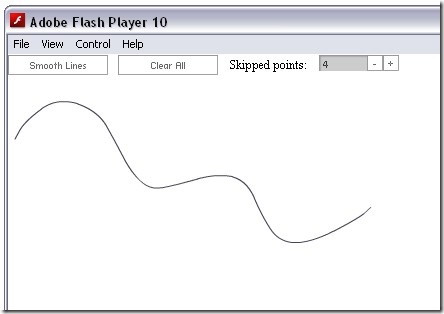
Simple AS3 Line Smoothing

While researching for drawing tools, I’ve come up with a simple implementation of a pencil tool and line smoothing.

Here’s the idea:

  • Capture the points drawn by pencil tool in an array.
  • Filter a new points array from the original one by skipping points in the middle (to reduce turns & angles)
  • Finally, use a simple point-to-point curve drawing algorithm. I use sample code from this article by gskinner.com

The result:

Click to view the demo

You can find the source of this demo here.

[Vietnamese tag: Làm mượt nét vẽ đơn giản với ActionScript]

28 March 2010

as3signals: new approach for AS3 Events

There are times you may find that the built-in events of AS3 are limited and even troublesome. Here are some circumstances that EventDispatchers turn against developers:
  1. Objects MUST extend EventDispatcher in order to be able to dispatch events. Implementing IEventDispatcher alone is impossible because the event target is read-only and you cannot change it from outside of EventDispatcher.
  2. It’s difficult to manage events. There’s no way you can remove all event handlers attached to an event dispatcher at once. So in some cases, you don’t remove them properly and they start causing bugs. (BTW, using weak references is not reliable and not recommended.)
  3. You cannot pass extra data to you listener unless you extends a new Event object
  4. You cannot set up your interface in a way that it can enforce implementing classes to dispatch the required events.
  5. On performance perspective, creating objects is one of the most evil things. That’s why any advanced programmers must know and practically use objects pool. However, we are still wasting a lot of resources creating event objects, especially repetitive events like mouse move or enter frame.
  6. Read here for more critiques on AS3 events
So in order to address those issues, Robert Penner has adopted an alternative to AS3 events namely as3signals. (Follow the link for more info and get the library)

21 March 2010

AS3 Type Conversion & Common Mistakes

In this article, I’ll discuss some common mistakes that AS3 developers (including myself) often make when working with (implicit) type conversion.

1. Check whether a dynamic property is set

Dynamic properties can be added to dynamic object at run-time. Consequently, there’s often a need to test whether they are set before using them.

Here’s how some developers do it:

  1. var initObj: Object = {embed: true, color: 0xFF0000, text: "Hello" };
  2. /* ... */ 
  3. if (initObj.embed) { /*apply embed*/ }
  4. if (initObj.color) { /*apply this color*/ }
  5. if (initObj.text) { /*apply this text*/ }

The first test with Boolean is ok. But be careful when the input for color is black (0x000000) or the text is empty (“”). In that case, zeros and empty strings casted to Boolean equal false, and definitely the code will run incorrectly.

So, the best practice to check whether a dynamic property is set is to do as following:

  1. if (initObj.embed != undefined)
  2. if (initObj.color != undefined)
  3. if (initObj.text != undefined)